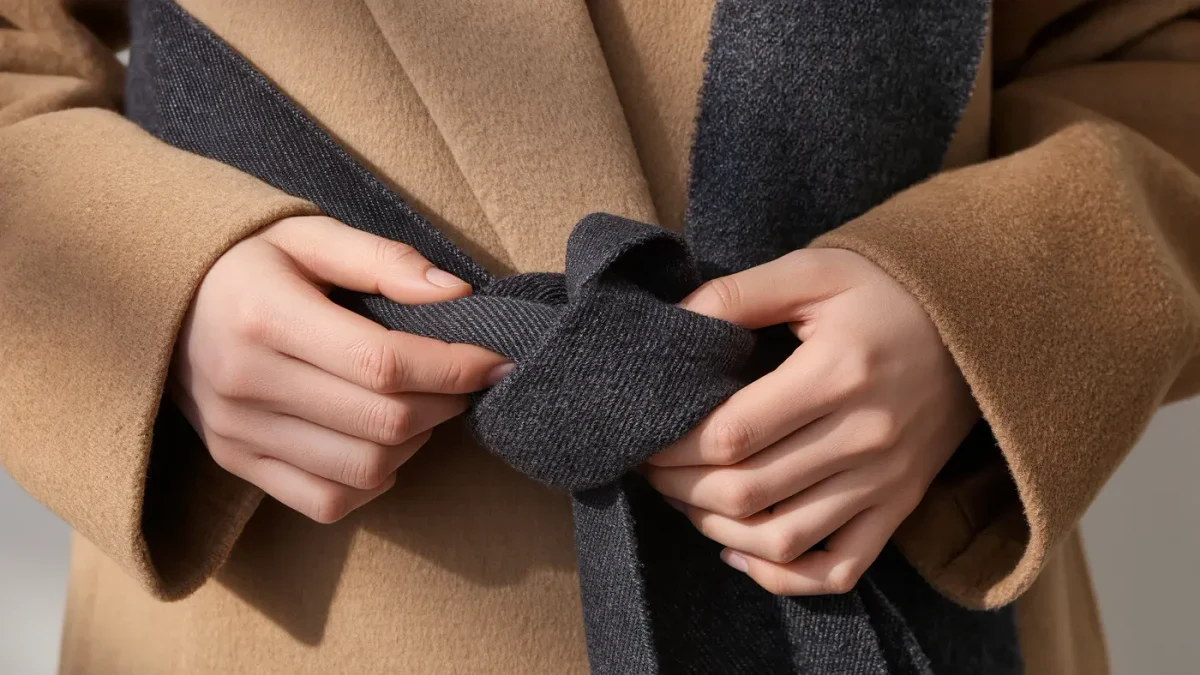
Four knots cover every scarf situation you will meet: the once-around for everyday warmth, the loop-through for wind and deep cold, the over-the-shoulder drape for weight without knots, and the bandana fold for silk squares and shoulder coverage. Each changes what the scarf does to the outfit — one adds structure at the neck, one adds volume at the chest, one adds a vertical color line. Start with the once-around; it is the default from which the others adapt.
Zebule publishes information, not styling or shopping advice; choose the knot that suits your own coat necklines and climate.
What changes between one scarf knot and another?
Three things: where the volume sits, how much neck coverage you get, and how visible the scarf's pattern stays. A tight loop keeps pattern visible on both ends and warmest at the throat; a drape shows mostly one long color line down the body. Since a scarf is often the most saturated thing you wear, deciding what the knot shows matters as much as deciding the knot itself. Wool scarves roughly 30 centimeters wide and 180 long handle all four methods; silk squares need the bandana fold.
How do you tie the once-around?
- Center the scarf behind your neck and let both ends hang even at the front. Skip centering if one end is meant to hang longer — asymmetric once-arounds are legitimate.
- Cross the ends once at the chest and bring the working end around the back of the neck, over the scarf, and down the other side.
- Adjust the loop height: two fingers of space under the chin for a relaxed look, close to the collar for real warmth. The loop should sit flat, not twisted.
- Let both ends hang free and even them out at mid-torso, or tuck one end through the loop at the chest to keep it from swinging in wind.
The once-around adds a soft ring of volume at the neck and keeps both pattern ends visible. It suits coats with open or low collars. Skip it under a zip-up collar — the loop bunches against the zip and forces the scarf up under your chin.
How do you tie the loop-through?
- Fold the scarf in half and drape it behind your neck, creating a loop on one side and two ends on the other. This method needs length: if the folded scarf ends above your waist, choose a different knot.
- Pull both ends through the loop together and snug the loop up to the neck by holding the ends and sliding the loop down.
- For deep cold, take a second pass: bring the ends around the back and through the loop again if length allows. Each pass adds a layer of still air at the throat, which is where the warmth actually comes from.
- Flatten the loop across the collarbone so it sits as a band rather than a rope. A rope-like loop reads heavy; a flattened loop reads like part of the coat.
The loop-through changes the warmth level outright: the doubled fabric blocks wind at the most exposed point of the body, which matters once temperatures force a real scarf decision. Skip it with bulky knits — the double thickness plus a chunky collar swallows the neck entirely.
When does the over-the-shoulder drape work?
- Drape the scarf around the back of the neck with no knot at all, one end hanging much longer than the other — roughly knee-length on the long side.
- Take the long end and throw it over the opposite shoulder so a single panel lies flat across the chest and down the back.
- Smooth the panel across the shoulders and let the short end hang at the front, if you want a small counterweight, or hide it behind the long panel.
The drape changes the outfit's vertical: it draws one uninterrupted color line from shoulder to hem, which lengthens the whole look — the scarf behaves like part of the coat rather than an accessory on it. Skip it in real wind and on slippery silk; both slide the panel off within minutes.
How do you tie a silk square?
- Fold the square in half corner to corner into a triangle, then fold the long edge over twice in bands about 4 centimeters wide until you have a single band. Crisp folds are what keep silk from collapsing into a rope.
- Place the band at the back of the neck and cross the ends once at the front, bringing them around to the side of the neck.
- Knot once at the side, just below the ear, with the knot facing out. A side knot keeps the band visible from the front and sits clear of most coat collars.
- For shoulder coverage instead, skip the neck: tie two opposite corners of the open triangle behind your neck so the triangle drapes over the chest like a small shawl.
The bandana fold changes the register of an outfit in a way no wool scarf can: a thin line of pattern at the neck reads considered even over a plain tee. Skip it entirely for warmth — silk is decoration, not insulation, and treating it as one gets a cold neck.
Which knot for which coat?
Open-collared wool coats take the once-around; zip and high collars take the loop-through or the drape over the top; tailored coats take the drape for line, or the bandana fold for pattern. One last check before leaving: if the knot needs constant re-tying, the fabric is either too slippery for that knot or the scarf is too short for the second pass — both are fixed by switching methods, not by tying tighter.
Sources for this piece include why covering the neck and mouth matters in cold weather, per Mayo Clinic.
For more context, read How to Store Sweaters So They Keep Their Shape.
For more context, read How to build an outfit around one color.
For more context, read How to Tuck a Shirt Three Ways.