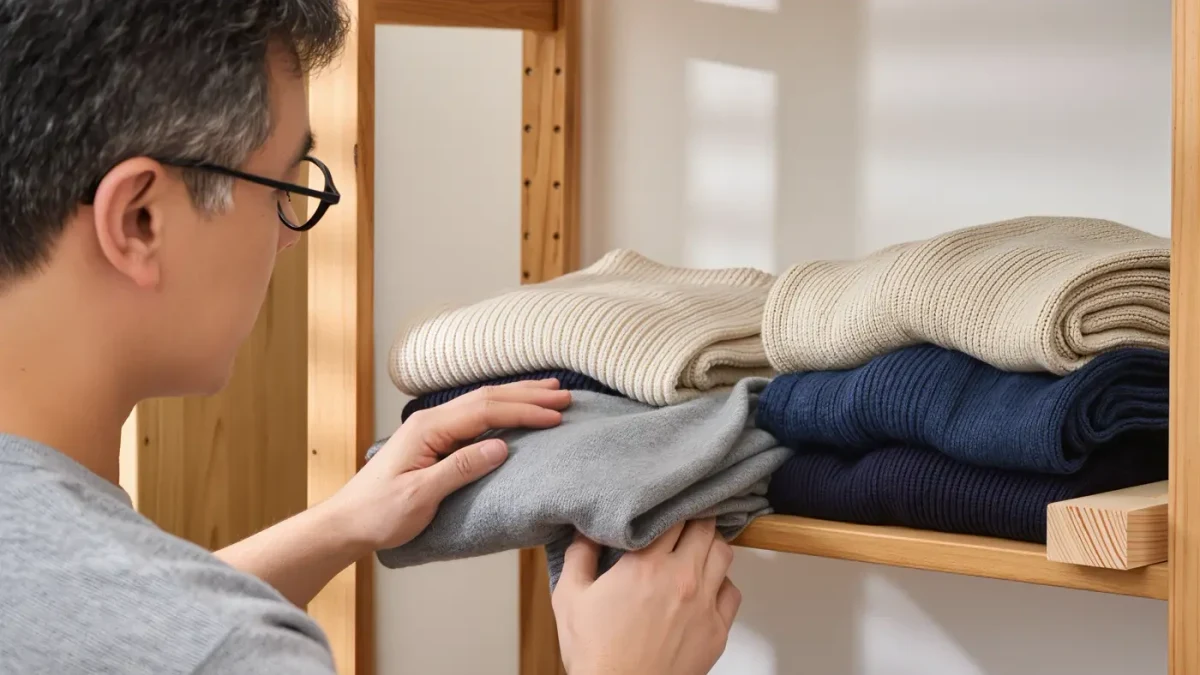
Sweaters keep their shape in storage by being folded, not hung: hangers stretch shoulders and collarbands permanently, while a proper fold carries the garment's weight across its whole surface. The rest of the method is three storage conditions — dry, dark, breathable — plus one habit, washing before the seasonal put-away. Start with the fold below; it takes ten seconds per sweater and prevents the two most common losses, the shoulder bump and the stretched neckline.
Zebule publishes information, not care or product advice; these are widely accepted home practices for wool, cashmere, and cotton knits.
Why do hangers ruin sweaters but not shirts?
A shirt distributes its own light weight along woven fabric that resists stretching; a knit hangs its whole weight from two points of gravity load — the shoulder seams — and knit loops creep under sustained tension. Wool creeps slowly, cotton faster when humid. The result is the pair of bumps at the shoulder, a drooped hem, and a collarband pulled wide, none of which press out, because the loops have migrated rather than creased. Gravity did it in months what wear would take years to do.
How do you fold a sweater properly?
- Lay the sweater face-down on a flat surface and smooth the sleeves out to the sides. Face-down protects the front's surface and any pattern from the fold lines.
- Fold each sleeve diagonally across the back so the cuff lands near the opposite hem corner — a slight angle, not a straight cross. The diagonal keeps bulk out of one line.
- Fold the body in thirds: one side over the sleeves, then the other, overlapping in the middle. You now have a rectangle with no single heavy fold crossing a shoulder seam.
- Fold in half or thirds from the hem up to the collar, keeping the collar on the outside of the bundle. A collar buried inside the stack gets crushed; on the outside it holds its shape.
- Stack no more than three high, heaviest at the bottom. Weight is the quiet enemy: a cashmere sweater under six others takes a set. If shelves force height, interleave with acid-free tissue and rebuild the stack monthly.
The fold changes what carries the weight: the garment rests on its whole area instead of hanging from two seams. Skip the tissue for everyday shelves — it earns its place only for long seasonal storage and very fine cashmere.
What conditions does stored knitwear need?
- Store dry, dark, and breathable: a cotton or canvas bag, a lidded cedar chest, or a shelf with airflow — never sealed plastic, which traps residual moisture and invites mildew and yellowing. Wool needs to breathe even in storage.
- Wash before the seasonal put-away. Body oils and invisible spills are what moth larvae feed on; a clean sweater stores safely, a worn one is bait. This one habit decides more of your knitwear's fate than any repellent.
- Control the moth risk in layers: clean garment, sealed container or tight-weave bag, and cedar blocks refreshed by sanding every season — cedar's oil fades, and a block that has gone dry and gray is furniture, not protection. Lavender sachets refresh similarly. Skip mothballs for clothes you wear; their odor permeates fibers and needs weeks of airing to leave.
- Check the stack monthly in the warm months. Look for threadbare pinpricks, fine webbing, or tiny cylindical pellets — early detection turns a loss into one garment to clean and one drawer to treat.
Conditions change the risk, not the shape: the fold handles shape, environment handles survival. Skip nothing in the pre-storage wash — it is the layer every other step depends on.
How do you store sweaters in season, not just off-season?
The same rules scale down: a folded stack on an open shelf beats a packed drawer for anything with a collar, and rotation matters — give a worn sweater a full day of rest folded flat or draped width-wise over a chair back before the next wear. The rest day lets the knit's own recovery smooth wear creases and release moisture; daily re-wear is how elbows and cuffs bag out long before storage is ever the issue. If a dresser is the only option, fold along different lines each time you refold, so no single crease becomes permanent.
Can a stretched sweater be fixed?
Often, yes — the gravity-stretched kind. Soak the sweater in cool water with a capful of hair conditioner for about 20 minutes to relax the fibers, press water out in a towel, then dry flat while easing the shoulders and hem back toward their original measurements. What does not recover is a hanger-stretched neckline on loose-gauge knit that has been stretched for months; the loops have migrated too far. The fix is prevention, and it costs one fold and ten seconds.
Sources for this piece include National Park Service guidance on storing textiles.
For more context, read How to Wash Wool Without Shrinking It.
For more context, read temporary hem fix.
For more context, read How to Roll Your Sleeves Neatly, Three Ways.