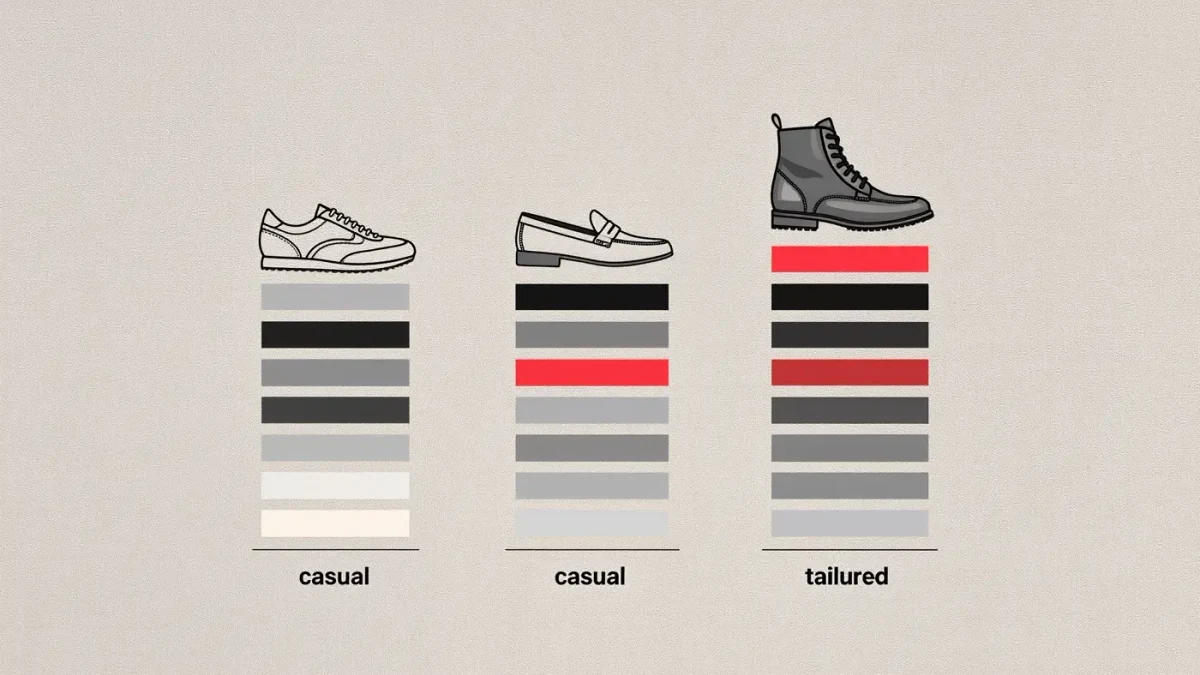
Most people dress top-down: shirt, then trousers, then whatever footwear survives the state of the floor. This column argues the order is backwards. The shoes are the outfit's foundation in the literal, compositional sense — they set the weight, the formality, and the visual temperature that everything above must answer to — and building from them upward is the single habit that most reliably makes wardrobes cohere. The garment closest to the ground decides more than the garment closest to the mirror.
The desk's case rests on composition and on how outfits are photographed and read at street distance; no closet confessions are offered or required.
Why do shoes set the outfit's terms?
Three mechanisms. Weight: the shoes carry the outfit's visual anchor, and a light shoe under heavy layers — or the reverse — makes the whole figure read bottom-heavy or unmoored. Formality: footwear signals the outfit's register faster than any other piece; trainers under tailoring say one thing, derbies under jeans say another, and the eye resolves the intended message from the ground up. Temperature: shoes decide the hem decision before it is made — a cropped trouser that ends perfectly above a loafer ends ambiguously above a chunky boot. Note that all three operate before color has said anything.
The photographic record makes the point repeatedly: in full-length street photography, the eye enters at the face, drops for the fit, and settles on the feet. The shoes are the last thing seen and the thing the viewer keeps.
What happens when shoes are the afterthought?
The signature failure is the outfit that is 90 percent considered — good coat, good knit, good trousers — finished with a worn all-rounder chosen for convenience. The 10 percent at street level taxes the other 90, because viewers weight ends over middles: face and feet. The mirror compounds the error, since most mirrors and selfies crop at the knee; the feet are where an outfit's quality leaks out unseen by its wearer. A practical countermeasure costs nothing: photograph outfits full-length, shoes included, and judge the whole frame.
Which shoes earn the foundation role?
A small rotation covers nearly all registers, which is why shoes are the right place to concentrate a budget after outerwear. A clean white or off-white leather trainer handles casual-to-smart-casual. A brown or black penny loafer in smooth leather handles everything from denim to odd jackets; a modest pair sits around the $150 mark at last check, while the same shape in Goodyear-welted construction runs $350 and up — the welt being the part that makes resoling possible, converting price into years. A plain leather boot covers bad weather and rougher registers. That is three pairs answering most weeks; a fourth, a formal derby or a heeled shoe per the wearer, completes the ladder.
The selection criteria beat the label: leather that creases rather than cracks, a sole construction that can be repaired, and a shape whose toe is neither a novelty nor a knife. Comfort is a selection criterion too, properly understood — an unwearable foundation drags every decision above it down to the floor.
Maintenance belongs in the argument, because a foundation is only a foundation while it is kept. The rotation above survives on fifteen minutes a week: a brush-down of dust and salt, an occasional cream for the leather, cedar trees inserted while the pair rests a day between wears, and wet shoes dried slowly away from radiators, which cook stiffness into leather. Heels and soles are consumables — a cobbler replaces them long before the upper gives up, and the receipt is a fraction of replacement. The habits are unglamorous and decisive: the best-shod people on any street are rarely the biggest spenders, only the most routine ones.
Does dressing from the shoes up actually work in practice?
As a planning habit, yes, with one honest caveat: it works when the shoe rotation is itself disciplined. Starting from an undisciplined shoe closet just relocates the chaos. The sequence that pays is rotation first, then habit: choose the day's shoes from a small, register-ordered rotation, then let the hem, the trouser weight, and the layers answer upward. The closet above stays exactly as it is; only the order of decisions changes, and with it the coherence of what leaves the front door.
The thesis, restated at street level: an outfit is read from the face and the feet, and only the feet can be replaced for $150. Start there. The rest of the look has no choice but to keep up.
Sources for this piece include Reuters business coverage of footwear retail.
For more context, read How to read a clothing label before you buy.
For more context, read The case for dressing the same every day.
For more context, read The case for one good coat, argued once and properly.