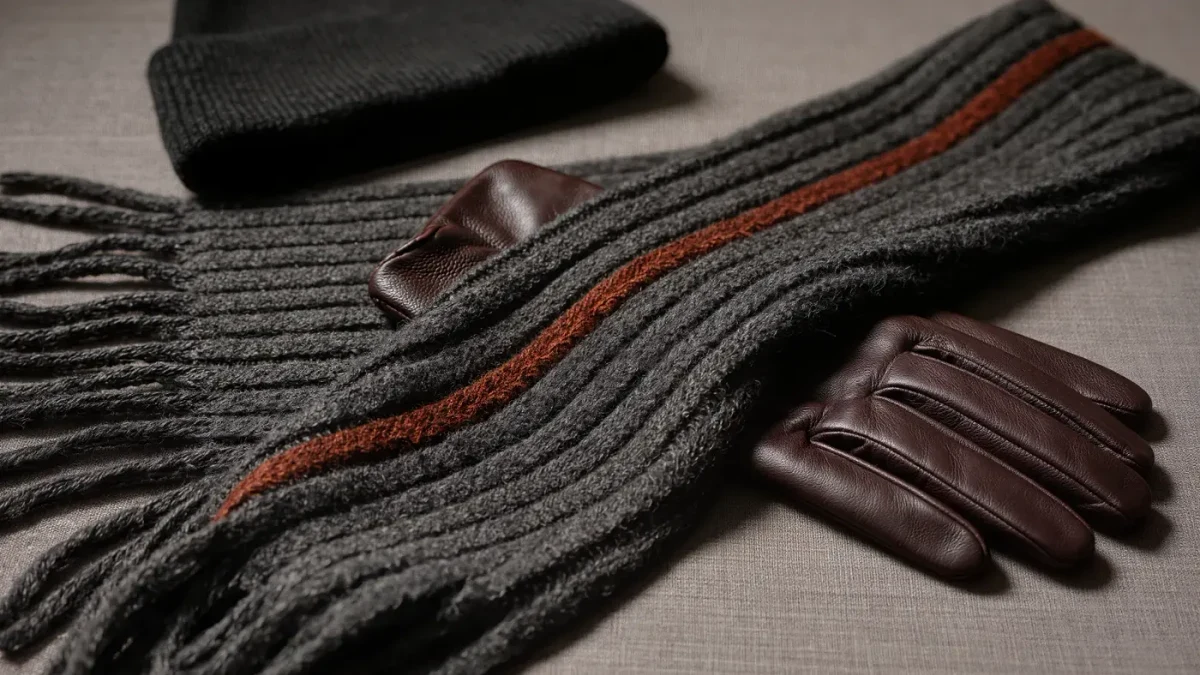
Winter accessories are the cheapest place to look expensive and the easiest place to waste money, because trend shapes date in one season while fibers last a decade. The argued selection: five accessories chosen on fiber content and function, priced as market examples at last check, February 2026, each with the reasoning that keeps it in a wardrobe past next winter. If you buy through links in our shopping guides, Zebule may earn a commission at no cost to you.
Why fiber first, shape second?
Because the shape is what goes out of date and the fiber is what keeps you warm. A wool scarf in a timeless width works under any coat; a novelty pom hat is obsolete by March. Cold-weather dressing is also a warmth problem with real stakes — the Mayo Clinic notes that hands and head lose heat quickly in cold conditions, and wet gloves lose insulation value entirely, which is why the function column below is not decorative. Warmth is a fiber property: wool and cashmere insulate even damp, acrylic does neither.
The edit: five picks and the argument for each
- The wool scarf in a solid mid-weight, around $80 at last check. The argument: one scarf in navy, charcoal, or camel does more for a winter outfit than any coat upgrade, because it sits at the face and reads first. Choose a width around 30 centimeters and a length that wraps once with ends past the waist — longer lengths tangle under coat lapels.
- Wool or leather gloves with a real lining, around $90 at last check. The overspend candidate, deliberately. Gloves fail from the lining out: unlined leather stiffens, acrylic linings mat. A cashmere-lined wool or deerskin glove at $90 outlives three $30 pairs, and hands are where cheap shows first in every handshake.
- The ribbed wool beanie, around $45 at last check. The anti-statement pick: a ribbed knit in a solid color, cuff turned, no logos and no pom. The argument is fit — a beanie should cover the ear tops and sit above the eyebrow. Ribbing is the construction detail that keeps its shape after a season of pockets.
- The merino neck gaiter, around $35 at last check. The sleeper pick and the best value on the list: a merino tube scarf replaces the scarf on active days, packs to the size of a fist, and works under a coat collar where a wrapped scarf adds bulk at the chest. Skip fleece versions — they pill and hold odor.
- The leather belt in dark brown, around $70 at last check. Winter's forgotten accessory: black-belt-everything is the default, and a dark brown belt with welted boots is the pairing that makes winter outfits read as considered. Full grain, a simple buckle, no contrast stitching.
Which one is worth overspending on?
Gloves, on replacement-cycle arithmetic: the $90 pair amortizes below any run of cheap pairs, and gloves are the accessory most often lent, lost, and replaced — which is an argument for quality in the pair you keep, not a reason to buy five. The scarf is second, but ceiling-capped: past roughly $150 you are buying brand or fringe finishing, not warmth.
What to skip entirely
Novelty hats with slogans, tech-fiber gloves with unusable fingertips, wire-and-yarn infinity scarves that mat after two washes, and any glove advertising touchscreen compatibility as its headline feature — the coating is what wears through first. Cold weather rewards boring choices; the accessories that outlast trends are the ones that never announce a season.
How do you care for winter wool accessories?
Hand-wash wool scarves and beanies cool, dry flat, and store clean — moths seek out body oils in stored knits, so a scarf put away dirty is a scarf offered to larvae. Leather gloves need a wipe-down and a cool, dry drawer, never radiators, which crack linings. Rotate two pairs of gloves through the week and each pair dries fully between wears, which is what keeps linings alive.
Which colors make all five accessories interchangeable?
The buy-once argument only works if the accessories interlock, and interlocking is a color decision made once. The argued palette is three neutrals and one accent: charcoal, camel, dark brown, and a single deep accent — rust or forest — that appears in exactly one piece, ideally the scarf, where it sits at the face. Charcoal is the workhorse because it matches both black and brown footwear without committing to either side of the old belt-and-shoes debate. Camel is the warm neutral that makes winter coats read expensive, and dark brown leather accessories — belt, gloves — are what stop a winter outfit from reading as an all-black default. The accent is rationed because accents scale badly: an orange beanie is a personality, an orange scarf is an outfit. Skip ivory and white entirely in accessories; they gray out in the wash and show city grime within a season, which quietly converts them back into replacement items — the exact outcome this list exists to prevent. Bought this way, the five pieces generate every winter combination the wardrobe needs, and each new coat inherits a working accessory set on day one.
A last note on gifting, since accessories are winter's default present: the same framework applies, inverted. Fiber-first picks are safe gifts precisely because they never announce a season — a ribbed merino beanie in charcoal cannot be wrong the way a novelty hat can, and the giver spends once for a decade of somebody else's cold mornings.
The thesis: buy fiber, skip the silhouette, overspend exactly once — on the gloves — and the same five accessories will still be correct in a decade.
For more context, read Five Wardrobe Staples Worth Buying Once.
For more context, read How to read a clothing label before you buy.
For more context, read How to read a fabric label before you buy.