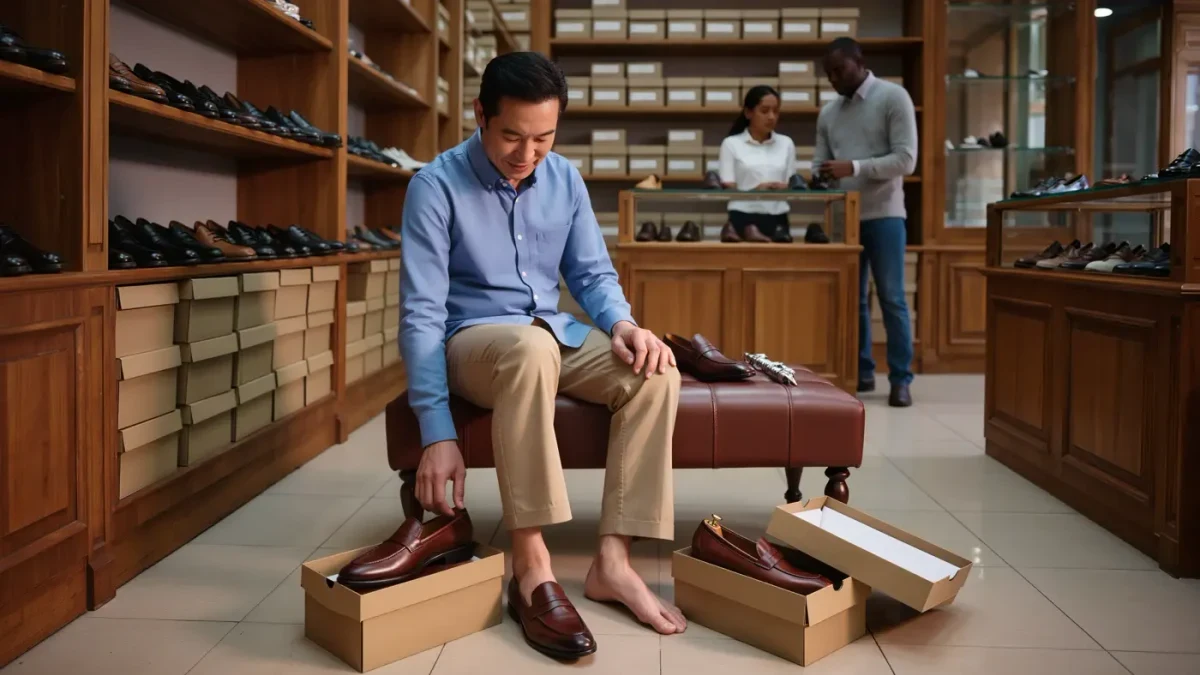
In loafers, the jump from $70 to $350 buys exactly one irreplaceable thing: construction, meaning the shoe is stitched rather than glued together. Everything else — the leather grade, the sole material, the last — exists in useful form at the middle tier, around $150 to $250 at last check (February 2026). This edit walks the loafer through its three price tiers and argues where the premium is justified, with picks as market examples verified against typical listings. If you buy through links in our shopping guides, Zebule may earn a commission at no cost to you.
What does the $70 loafer get you?
A look, for a season. Low-tier loafers are cemented construction: the upper glued to a rubber or leather-board sole. The failure pattern is predictable — the sole separates at the flex point under the ball of the foot, usually inside twelve to eighteen months of regular wear, and no cobbler can resurrect a cemented shoe worth resoling. The leather is corrected grain, heavily finished so it cracks at the vamp crease instead of developing one. For occasional wear — dinners, interviews — a $70 pair is honest arithmetic. For a daily shoe, it is a rental.
Why is construction the whole argument?
Because construction is resoleability, and resoleability is the price per year. A Blake-stitched loafer — the middle tier's standard — has its sole stitched directly to the insole; a cobbler can replace it two or three times. A Goodyear welt, common from $250 up, adds a strip of leather between upper and sole, making the shoe fully rebuildable and somewhat water-resistant. A cemented shoe has a lifespan; a stitched shoe has a maintenance schedule. One pair of $200 Blake-stitched loafers resoled twice over five years beats three pairs of $70 loafers on cost, comfort, and how they look in year three.
Comparing the three tiers
| Detail | ~$70 | ~$150–250 | $300+ |
|---|---|---|---|
| Construction | Cemented | Blake stitch | Goodyear welt |
| Leather | Corrected grain | Full grain calfskin | Named-tannery calfskin, suede |
| Sole | Leather board, glued | Leather or rubber, stitched | Welted leather, often with rubber insert |
| Resoleable | No | 2–3 times | Indefinitely |
| Best for | Occasional wear | The daily pair | A 10-year shoe |
Where does the top tier genuinely win?
In the last — the wooden form the shoe is built around. Expensive houses keep their own lasts, and a good last is the difference between a loafer you forget you are wearing and one you break in forever. If you have narrow heels or a high instep, this is where $350 buys something the middle cannot copy: a fit that does not slap at the heel when you walk. Fit failures are why loafers get abandoned, and no construction standard fixes a wrong last.
Which loafer shapes are worth the mid tier?
- The penny loafer, around $200 at last check. The permanent one: works with raw denim, flannel trousers, and a suit. Choose the least ornamented version you can find — the shape carries it.
- The horsebit loafer, around $180 at last check. The dress-leaning pick; the metal bit is where cheap versions look cheapest, so this is the shape to buy in real calfskin or skip.
- The suede loafer, around $170 at last check. The texture argument for spring and fall — suede softens anything it is paired with. Budget for a suede brush and accept weather days off.
- The chunky-sole loafer, around $130 at last check. The trend entry, and the correct place to spend less: lug soles date first, so mid or low tier here, higher tiers for the classic shapes.
How do you test a loafer in the shop?
- Flex the toe upward: a stitched sole flexes with a subtle resistance; a cemented one feels like bending a sandwich.
- Look inside at the heel: a stitched shoe shows a row of stitches or a leather sock with visible construction; pure smooth glue line, no.
- Pinch the vamp leather — full grain rebounds; finished leather holds a crease you just made.
- Walk the shop length: any heel slap at purchase only gets worse.
How do you care for loafers so the tier pays off?
Stitched construction is a promise that only care keeps. Cedar shoe trees go in within an hour of taking them off — leather holds the shape of its last wear, and a crease set by a damp evening becomes permanent by morning. Two pairs in rotation beat one pair worn daily, because a day of rest lets midsole moisture evaporate and roughly doubles upper life. Polish is maintenance, not vanity: a cream polish once a month feeds the upper, and unconditioned calfskin cracks at the vamp crease — the exact failure the full-grain premium was supposed to prevent. Suede needs its brush after wet days and nothing more; never suede-safe water sprays as a license for weather you would not wear wool into. The resole itself is a checkpoint: a cobbler replaces the sole before the heel wears through to the stitch line, and waiting past that point converts a $60 repair into an unrepairable shoe. Done this way, the middle-tier pair amortizes below any run of cemented pairs — and, the part no arithmetic captures, a maintained loafer at year four looks better than it did in the shop, which no disposable shoe ever manages.
The thesis: pay the middle tier for stitching, the top tier only for the last, and let the $70 pair handle the weddings.
For more context, read Five Wardrobe Staples Worth Buying Once.
For more context, read where to splurge and where to save.
For more context, read Five Everyday Bags Under $200, Argued Properly.