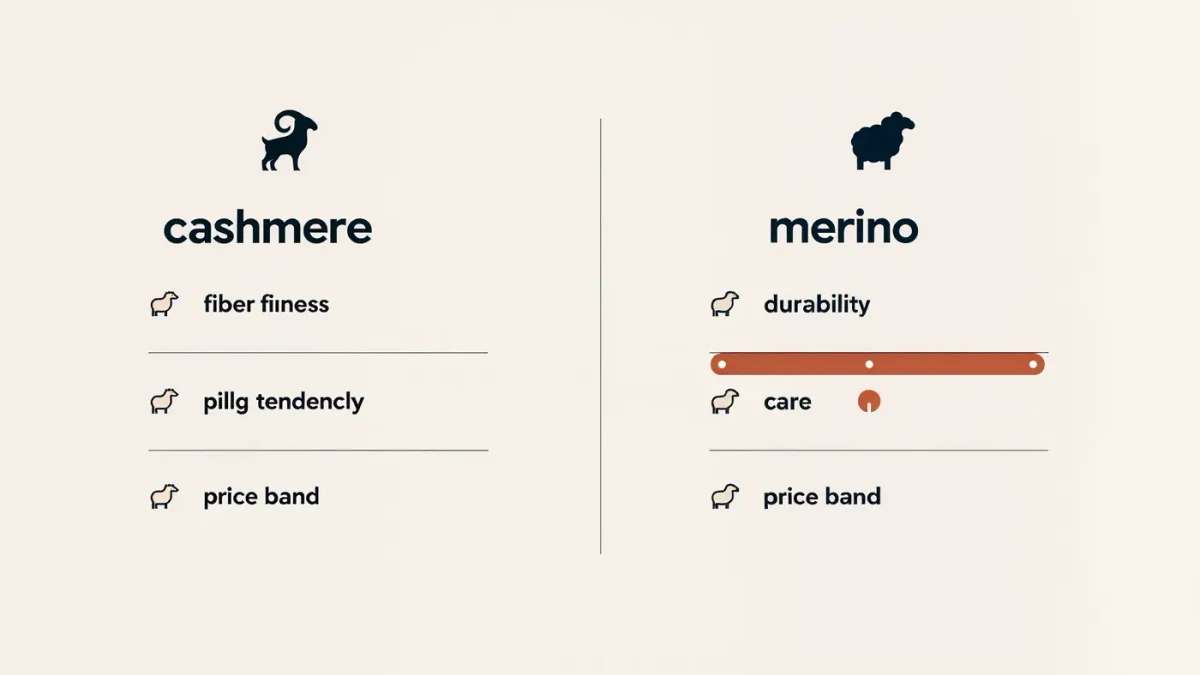
Cashmere or merino comes down to three decisions — next-to-skin softness, lifespan under friction, and price — and merino wins two of them for most people. Cashmere earns its premium only in fine gauges worn against skin or layered under collars; everywhere else, merino delivers comparable warmth and better durability for a third of the price. Here is the framework, with market examples priced at last check, March 2026. If you buy through links in our shopping guides, Zebule may earn a commission at no cost to you.
What is actually different about the two wools?
Species and fiber diameter. Merino comes from merino sheep; cashmere comes from the underdown of cashmere goats, and it takes several goats' annual underdown to make one sweater — the arithmetic behind the price gap. Cashmere fibers run finer, which is why fine-gauge cashmere feels weightless against skin where merino can still whisper an itch on sensitive wearers. But the same fineness makes cashmere mechanically weaker: it pills faster at friction zones and wears through at cuffs and elbows sooner. Merino's slightly thicker fiber is the durability argument.
When does cashmere win the argument?
Two cases. First, the next-to-skin problem: if merino itches you — and it genuinely does for a minority of wearers — no mid-tier merino will fix that, and fine-gauge cashmere around $200 at last check is the answer. Second, the layering piece: a whisper-thin cashmere crew under a blazer does a job no merino quite copies, delivering warmth without bulk at the sleeve. Note the pattern: cashmere wins in fine gauges, close to the body. It loses anywhere friction lives — outer layers, sleeves pushed up, bags and seatbelts against the back.
When does merino win?
Everywhere else, on the numbers. A mid-gauge merino crew around $110 at last check delivers comparable warmth to an entry cashmere sweater at roughly twice the price, survives friction seasons longer, and tolerates care better — superwash-treated merino even survives a gentle machine cycle. The FTC requires wool products sold in the U.S. to disclose fiber content truthfully, so the label settles the species question before the price does; the U.S. Department of Agriculture's wool and mohair program data shows the scale difference between sheep wool and goat-fiber supply if you want the production arithmetic.
The decision table
| Your situation | Buy | Why |
|---|---|---|
| Merino itches you | Fine-gauge cashmere | Sensitivity is not fixable; fiber fineness is |
| Layering under jackets | Fine-gauge cashmere | Warmth without sleeve bulk |
| Daily crewneck, high rotation | Mid-gauge merino | Durability at friction zones |
| Budget under $150 | Merino | Best fiber quality available at the price |
| Travel and packing | Merino | Odor resistance, machine-washable grades |
What should cashmere cost you, honestly?
Entry cashmere sits around $100–$250 at last check; premium grades run far higher. The grade behind those numbers is fiber length and diameter — longer, finer fibers pill less — but grading is not printed on labels, so treat price as a rough proxy and the hand test as the verifier: lightly rub the cuff against itself for ten seconds. Immediate fuzz clouds mean short fiber. Also treat too-good prices with suspicion: suspiciously cheap "cashmere" is often heavy surface treatment on short fiber, and it will pill in weeks.
How do you care for either wool so it lasts?
- Hand-wash cool with wool detergent, or wool cycle if the label permits; heat and agitation shrink both fibers.
- Dry flat on a towel, never hung — wet wool stretches to knee length permanently.
- De-pill with a cashmere comb, never a razor held carelessly.
- Store folded in a closed drawer with cedar; moths do not respect fiber price.
- Rest the garment a day between wears — both fibers shed odor overnight.
Can the two wools share one wardrobe?
Not only can they — the argued answer is that they should, because the two fibers solve different problems and the wardrobe that uses both spends less than one loyal to either. The working split: merino owns the friction layer. Crewnecks, shaker knits, travel pieces, anything worn under bags, seatbelts, and desk chairs — the mid-gauge merino there outlasts cashmere by seasons. Cashmere owns the skin layer: one or two fine-gauge pieces, a crew or turtleneck, worn against a shirt or on clean skin, never as the outer sweater on a commute. In practice the winter drawer holds perhaps six pieces — three merino for rotation, two fine-gauge cashmere for layering and sensitive-skin days, one heavy knit of either fiber for the coldest weeks — and the combined cost lands near what three premium cashmere sweaters would cost alone. The mixing also hedges the care problem: merino pieces survive the washing mistakes that would end a cashmere one, so the wardrobe's most fragile items are also its least-worn. What the split forbids is redundancy — owning a cashmere crew and a merino crew doing the identical job is the wardrobe paying twice for one slot, whatever the fibers.
One more practical note for the mixing strategy: buy the merino first, wear it a full winter, and let the itch question settle itself before any cashmere enters the drawer. Most wearers who think they need cashmere discover that their merino problem was actually a gauge problem — a coarse mid-gauge knit worn against a t-shirt, rather than merino itself. Cashmere bought as a hypothesis is the most expensive experiment in knitwear; cashmere bought after a season of evidence is the right one.
The thesis: buy merino for rotation and budget, cashmere for the fine-gauge pieces that touch skin — and never buy cashmere for a sweater whose elbows live in a desk chair.
For more context, read The Mid-Tier Merino Edit: Five Argued Picks.
For more context, read How to read a fabric label before you buy.
For more context, read How to read a clothing label before you buy.