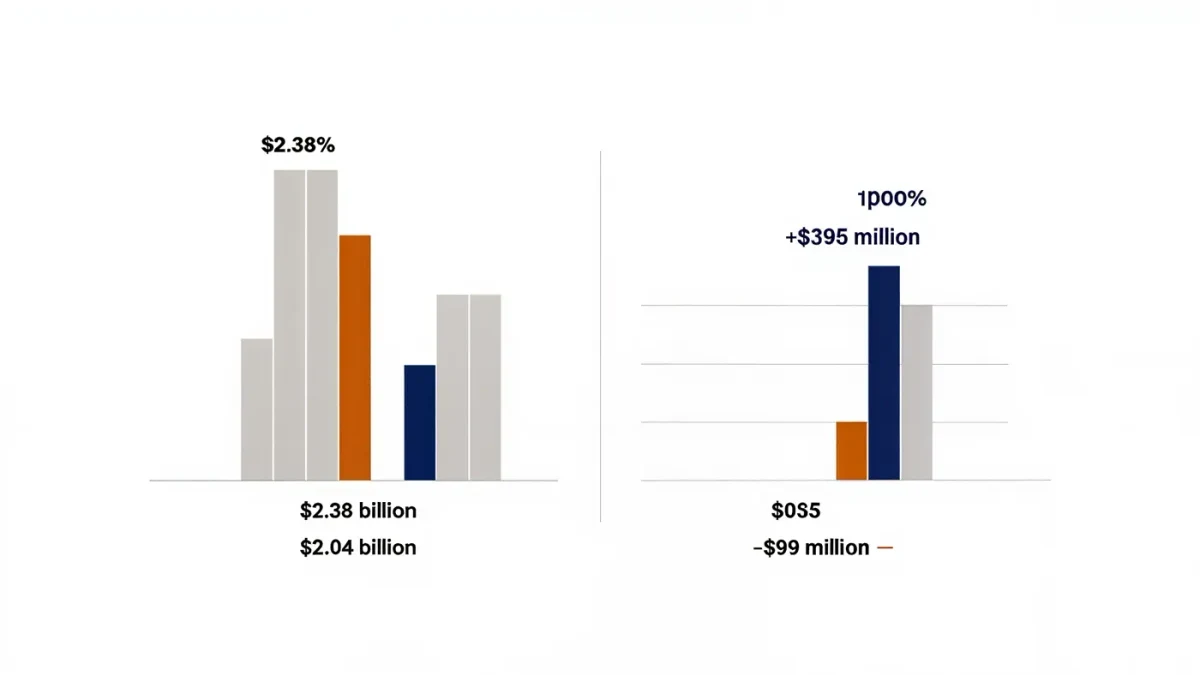
The company that defined ultra-fast fashion is shrinking in its biggest market. Per Reuters reporting dated July 26, 2026, Shein revealed key financials ahead of its planned Hong Kong initial public offering, and they showed US net revenue falling 14.3 percent in the first quarter of 2026, from $2.38 billion a year earlier to about $2.04 billion, with the company pointing to tariff impacts. The same disclosures showed a quarterly net loss of $99 million against a profit of roughly $395 million in the year-ago quarter. The de minimis era that let Shein ship billions of dollars of sub-$800 parcels into American homes duty-free is over — and the company's own numbers show what replaced it.
Zebule reports the figures, not investment advice: this is an analysis of disclosed financials as of August 2026, ahead of any listing.
What exactly did the disclosures show?
Per Reuters on July 26, 2026: US net revenue of approximately $2.04 billion in Q1 2026, down 14.3 percent year over year from $2.38 billion, with the US accounting for 22.5 percent of group revenue; a $99 million net loss for the quarter against a roughly $395 million profit a year earlier; and an explicit flag from the company that tariff impacts weighed on the business ahead of its planned Hong Kong listing. The broader context, documented through 2025 and 2026, is the elimination of the de minimis exemption for low-value parcels and successive tariff rounds hitting goods shipped directly from China — the exact channel ultra-fast fashion was built on.
Why did tariffs hit this business model so hard?
Because the model was an arbitrage. Shein's core loop — thousands of new styles a day, produced in small batches in China, flown individually to shoppers — worked partly because each small parcel crossed the US border without meaningful duty under de minimis rules. Once those parcels face the same tariff logic as container loads, the price gap between an $8 Shein tee and an $14 H&M tee compresses, and the gap was the product. The Q1 2026 loss suggests the company chose to absorb part of the duty rather than pass it all into prices — a defensive move while it prepares to court public-market investors in Hong Kong.
What this means for your wallet
First, the ultra-cheap baseline is drifting up: when the lowest-cost player loses its duty advantage, the whole entry tier of the market reprices — not dramatically, but enough that the psychological $10 threshold applies to fewer items. Second, expect assortment changes rather than just price changes: to rebuild margin, ultra-fast platforms shift toward higher-priced categories — home goods, beauty, heavier items — where a few dollars of duty matters less proportionally, which changes what fills your feed. Third, the competitive map redraws: rivals that never relied on de minimis — Primark's in-store model, H&M's regional supply chains, Amazon's domestic-fulfilled listings — regain ground on price parity, a shift the Primark trading update in June 2026 already reflected in resilient new-store growth. For shoppers, the practical consequence is modest: check the true landed price including shipping and returns, because the old calculation that made direct-from-China ordering automatically cheapest no longer holds by default.
Does the Hong Kong listing change anything for shoppers?
Indirectly, yes. A listed Shein must publish regular financials, which turns its pricing strategy into a quarterly spectacle — investors punish margin collapse, so the company faces sustained pressure to either raise prices or cut costs further in its supply chain. Whether its famed on-demand production can absorb tariffs through efficiency rather than price increases is the multi-year question; the first quarter of 2026 says it has not managed it yet.
For more context, read Tariffs added 3.1 points to goods prices — and clothing shoppers are paying it.
For more context, read primark sales 2026.
For more context, read lvmh first half 2026 results.