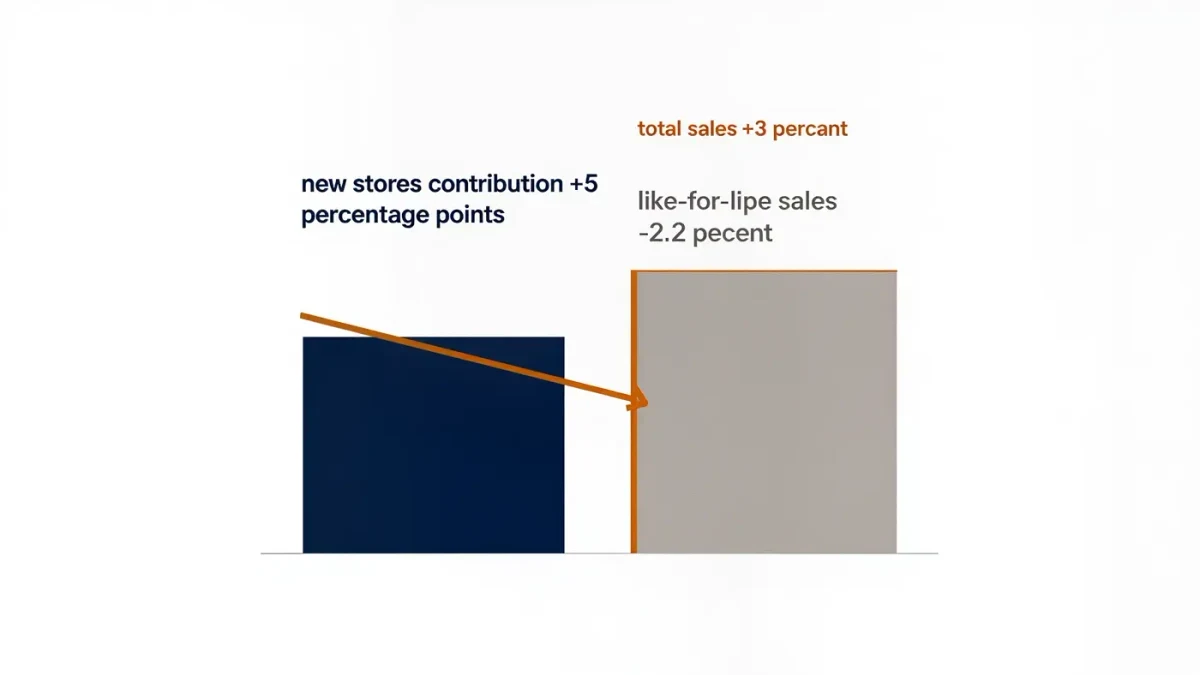
Primark, the Irish value-fashion chain famous for prices that make a $12 dress possible, grew its sales 3 percent in the 16 weeks to June 20, 2026 — but per the trading update its owner Associated British Foods published on June 30, 2026, essentially all of that growth came from opening new stores, which added 5 percentage points, while like-for-like sales declined 2.2 percent. New rooms are filling up; the old rooms are getting quieter. That spread is the clearest picture yet of how bargain fashion makes money in 2026.
Zebule reports the numbers, not investment advice: what follows is an analysis of a public trading update dated June 30, 2026, as covered by the company and Reuters on July 1, 2026.
What did the June 30 trading update actually say?
Associated British Foods' third-quarter update, released via the London Stock Exchange at 7 a.m. on June 30, 2026, covered the 16 retail weeks ended June 20, 2026. Headline Primark sales grew 3 percent, with revenue of £5.3 billion for the quarter at group level, per the company's release. Strip out the new-floor effect and the picture is blunt: UK sales up just 1 percent with like-for-like broadly flat, group like-for-like down 2.2 percent, which Reuters attributed to a challenging retail environment across most markets. Management held its full-year guidance for Primark, targeting an adjusted operating margin of around 10 percent, and reaffirmed plans regarding a potential Primark spin-off, per company statements and trade press.
Why new stores can grow sales while customers spend less
Value fashion is a volume and square-footage business. Primark does not sell online at scale, so every pound of growth has to physically happen in a store. When like-for-like sales fall while total sales rise, it means the average existing store is trading below last year — fewer items per basket, or cheaper items — and the company is outrunning that erosion by adding square meters in the US and Europe. Per the update, new store openings contributed 5 percentage points of growth across key markets including Europe and the US. The model still works, but it now depends on expansion discipline rather than on shoppers spending more per visit.
What this means for your wallet
For the shopper, the 10-percent-margin promise is the number to watch. A value retailer defending a margin target in a falling-traffic year has two levers: hold prices and absorb the hit, or nudge prices up on the items least likely to be compared — the impulse buys, the seasonal prints, the licensed collaborations — while keeping headline price points like socks and tees untouched. Primark's whole brand rests on the second approach being invisible. Expect the $12 dress to remain a $12 dress, and expect the subtle re-pricing to happen in categories where you do not memorize the price. The other wallet effect is competitive: when Primark's like-for-like numbers soften, its mass-market rivals — H&M, Zara's cheaper lines, supermarket fashion — typically respond with their own entry-price promotions in the back-to-school window, which historically is the cheapest stretch of the autumn calendar for basics.
Is cheap fashion dying, then?
No — it is migrating. The Primark update lands in the same season that US data showed tariff costs pushing into goods prices, which squeezes the import-heavy value segment hardest, since its goods cross oceans in containers at thin margins. The response visible in this update is spatial: grow where costs and competition allow it, hold the line in mature markets. The spin-off language matters too — separating Primark from the group's food and sugar businesses would let the value chain be judged, and financed, on its own retail math.
What to watch next
The full-year results, due September 2026, will show whether the like-for-like decline deepened over the summer trading weeks and whether the ~10 percent margin target survived. Between now and then, the back-to-school assortments in Primark's US and European stores are the practical test of how a value giant protects prices when its own traffic is softening.
For more context, read Louis Vuitton's parent just ended a seven-quarter slide — why that matters beyond luxury.
For more context, read shein us revenue 2026.
For more context, read hermès first half 2026 results.