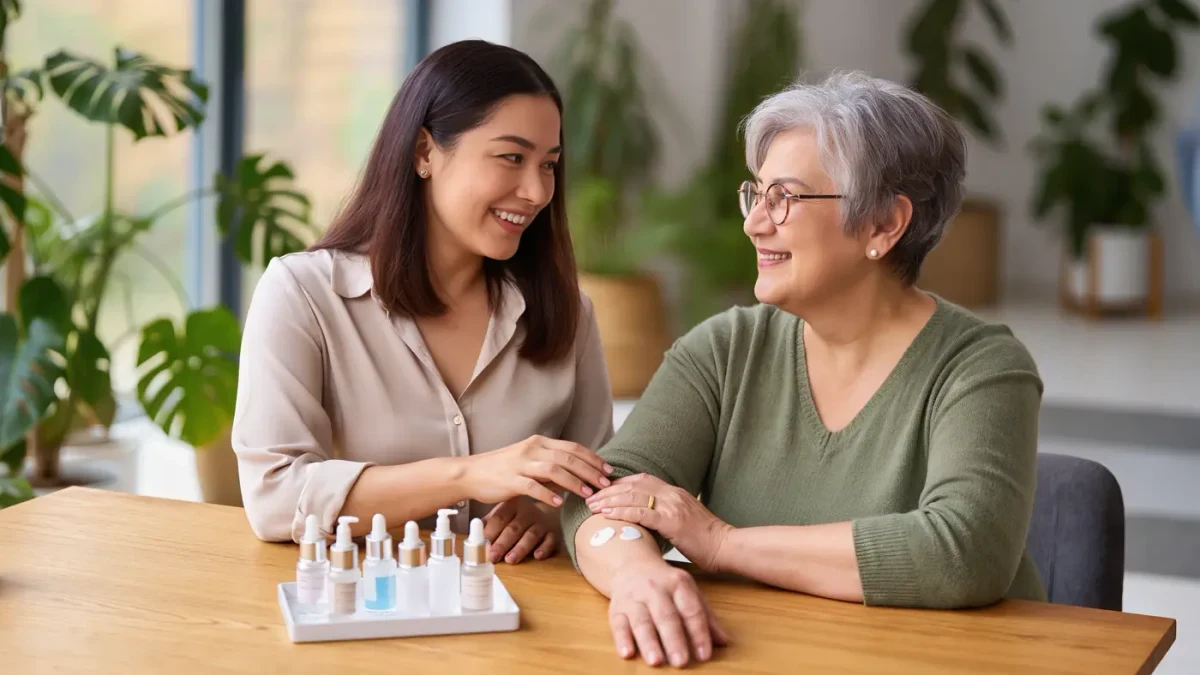
Per Global Cosmetics News in the week of May 11–16, 2026, Natura — the Brazilian group behind one of the world's largest direct-selling beauty operations — signaled further expansion across Latin America. The movement matters beyond market share math: it is a defense of the oldest social-commerce model in beauty, the consultant who sells face to face, at a moment when the industry assumed the algorithm had replaced her.
Standard note: this is industry reporting and analysis, not investment advice.
What is Natura, and why does its model still work?
Natura built its business on relationship selling: trained consultants, overwhelmingly women, selling skincare and fragrance within their own communities, with commission and flexibility as the compensation. In markets across Latin America, that model solves problems e-commerce still struggles with — trust, product trial on real skin, and beauty advice calibrated to local climate, skin tones, and budgets. A consultant demonstrates a foundation on your actual face and hands you a sample sized to your week. No livestream has matched that conversion, which is why the model persists from São Paulo to Mexico City.
Why is Latin America the strategic bet now?
Regional proximity, category dynamics, and competitive timing all point the same way. Latin American beauty markets combine young populations, high engagement with beauty as daily practice, and a rising middle class that trades up within trusted channels. For Natura, deepening the home region — per the expansion coverage of mid-May 2026 — concentrates capital where its logistics, brand equity, and consultant network are strongest, rather than fighting global giants dollar-for-dollar in the U.S. or China. It is focus dressed as expansion.
What this changes for how you shop
If you buy beauty online in Europe or North America, the lesson is indirect but useful: the direct-selling channel is a reminder that product knowledge is distributed unevenly, and the most accurate shade match you will ever get comes from someone who can see your skin in daylight. The trends it foreshadows — hybrid selling, where online ordering is fulfilled and advised by a local human — are already migrating north. For readers in the region itself, expansion typically means more portfolio localization: regional shade ranges, climate-appropriate formulations, and price points tuned to local currencies rather than converted from dollars.
What does direct selling look like in 2026?
Not your mother's catalog party. The consultant model has quietly digitalized: orders placed in an app, fulfilled from regional hubs, but advised, demonstrated, and followed up by a human who knows your skin history. The consultant is part seller, part diagnostician, part aftercare — the person who notices the retinol is being overused and says so before a returns form gets involved. Groups like Natura treat the network as infrastructure: training, product education, and now, per the expansion coverage, deeper regional logistics. The economics are less sexy than a viral ad but harder to displace, because the moat is relationships, and relationships do not scale by buying media.
The desk's read
The industry spends billions trying to synthesize what the consultant model had natively: personalization with accountability. Natura's regional bet is a wager that human distribution is an asset, not a legacy cost. Watch whether its expansion reporting pairs consultant counts with digital appends — the interesting future is not door-to-door versus app, but both in one relationship. For shoppers, the takeaway survives every reorganization: the best beauty purchase is the one where someone qualified looked at you first. The algorithm guesses; the consultant, the good ones at least, looked.
For more context, read 83 beauty deals in one quarter — what the M&A surge means for your shelf.
For more context, read ulta beauty raised outlook 2026.
For more context, read lvmh sells marc jacobs.